


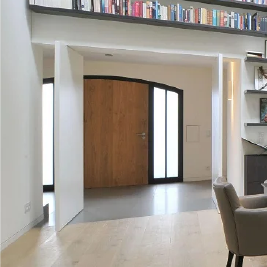



"We approached FritsJurgens very early, because we knew we wanted pivot doors. In terms of possibilities and quality, it was the obvious choice."
On a protected heath, where the ground is left to boulders, moss and low trees, Max Verhoeven of Studio Massimo has built an office that tries not to interrupt anything. It stands on the footprint of a cattle shed that once stood here. Nothing wider, nothing taller. The building takes the place of the shed and then steps back to let the landscape through.
Verhoeven designs by one rule: form follows nature. He spent a long time on the site before he drew anything, walking between the boulders and the moss, watching how the trees stood and how the light moved across the heath. Most of what he noticed ended up in the building.
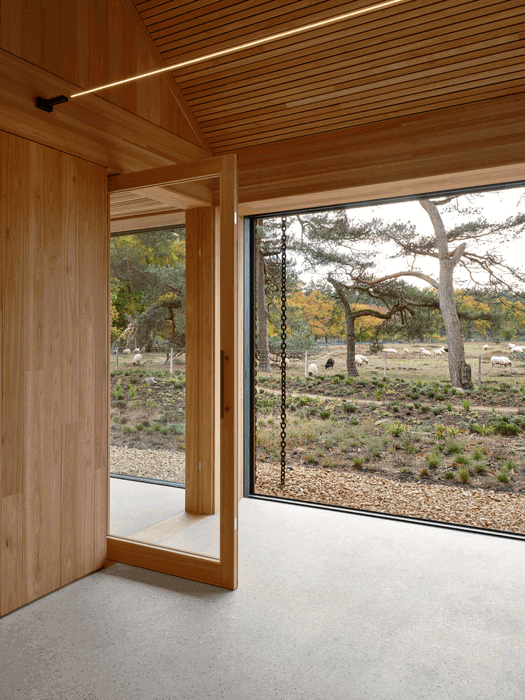
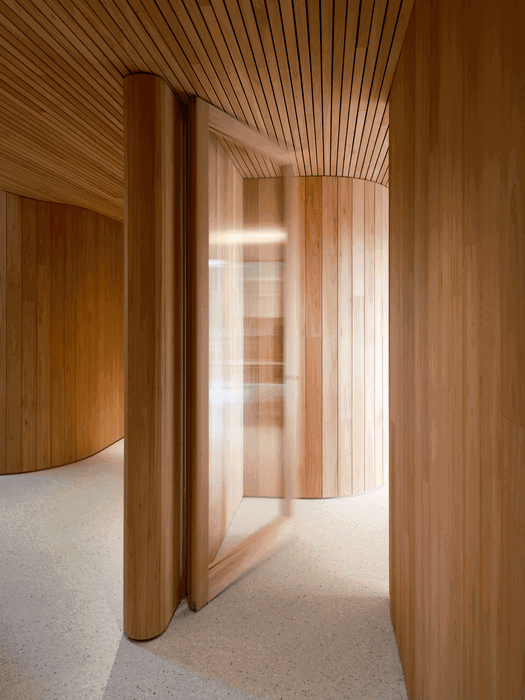
So the landscape runs right up to the plinths and carries on over the roof. The façade is poplar bark. Inside, the whole structure above your head is timber, so you enter something close to a tree. The openings are placed so that each view frames the heath like a painting, and the nature outside never quite leaves the room.
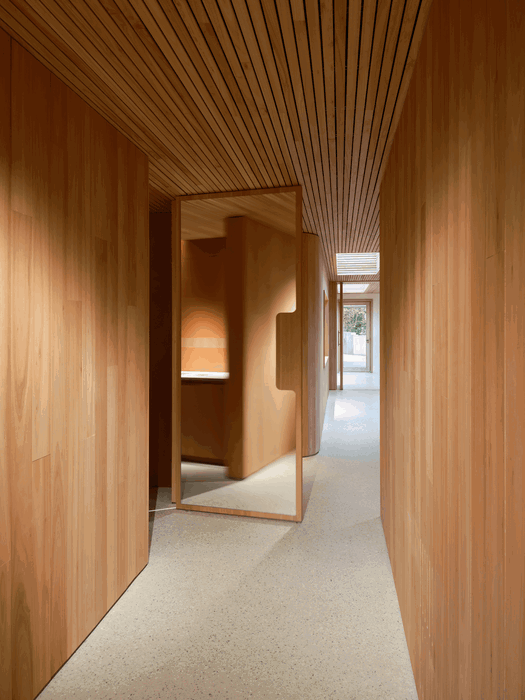
Inside, the mood softens. Verhoeven worked with curves rather than corners, and they hold the daylight in a way straight walls never manage. You move through the building along an easy, natural line, and the rooms open into one another instead of stopping at hard edges.
Doors that step out of the way
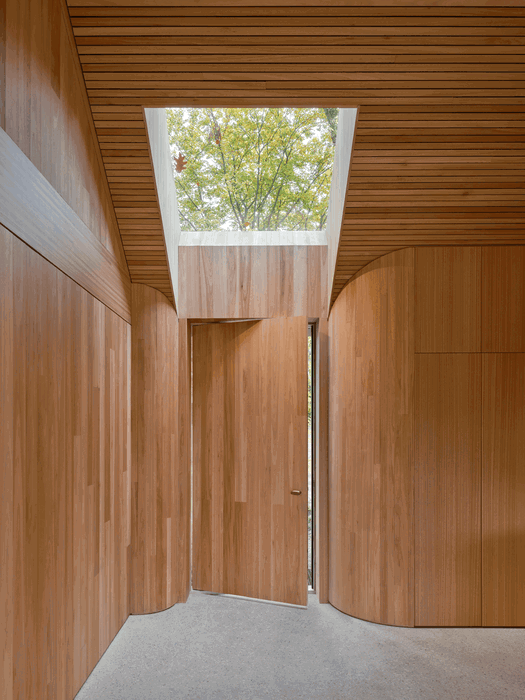
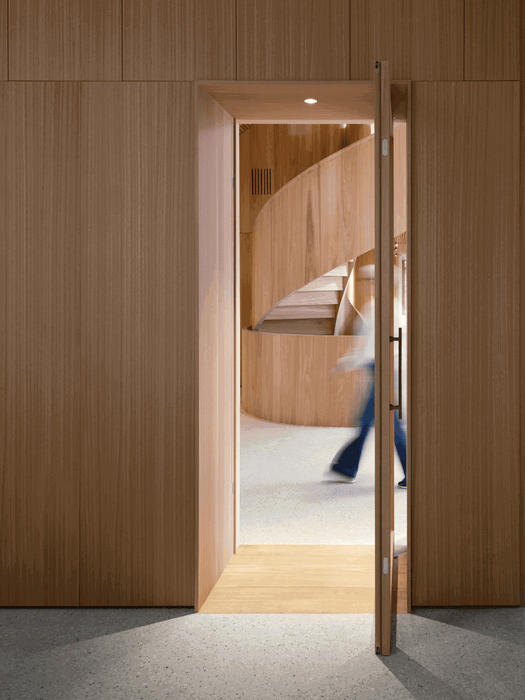
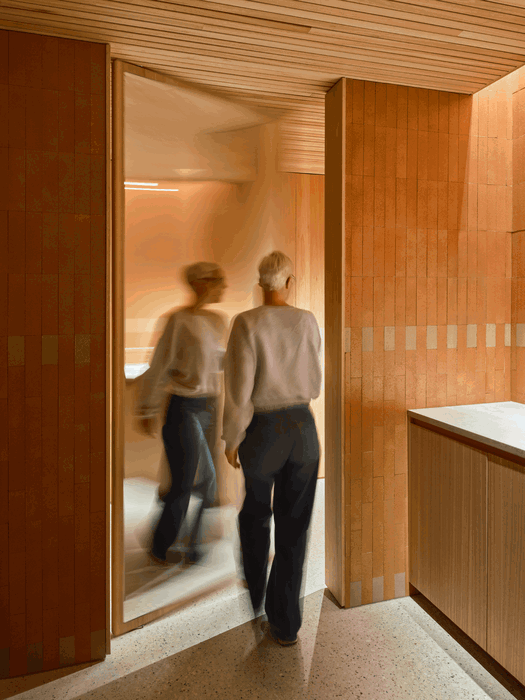
The building runs on one continuous route, and the doors along it are not meant to announce themselves. Open, they are almost not there.
"As soon as a door is open, you don't see the hinges at all. It feels as if you have one continuous route through the building."
That only works if the hinge genuinely disappears, which is where the conversation with FritsJurgens began. The system sits inside the door and the floor, so an open door reads as part of the wall, and the wall reads as part of the path.
An office asks something harder of a door than a house does: it has to handle sound. Rooms need to close off from one another, and a pivot door is not the obvious way to do that. So the first thing Studio Massimo and FritsJurgens worked out together was how to keep the pivot door and still get proper acoustic separation. The answer was drop-down seals combined with rebates. Shut, the door behaves like a quiet, solid wall. Open, it behaves like nothing at all.
Why FritsJurgens?
"What I like most about the FritsJurgens pivot doors is how effortless they are. Even with your hands full, a gentle push opens them and they stay open. A small tap with your foot and the door closes again, slowly. It is the smallest possible barrier when you still need a door."
That last line is the one we keep coming back to. A door is a barrier by definition, but it does not have to feel like one. A FritsJurgens system carries the full weight of the door out of sight and lets it move on a fingertip, which leaves the architect free to make the door as large, as heavy or as quiet as the design needs.
At Tafelberg that freedom was the whole point. The door had to disappear into a route, hold its own against sound, and still swing open from a shoulder when someone walks through with their hands full. It does. And it helped that Studio Massimo called early, while the hinge was still something the building could be designed around rather than fitted with at the end.