






Gap Calculator for pivot doors
A pivot door turns around its own axis, so its corners need room to pass the frame. Enter the opening, the door leaf thickness and the pivot point, and get the door leaf width with even gaps on both sides.
The calculator cannot be loaded right now. Please try again later.
FritsJurgens North America
Is FritsJurgens in the US?
Yes. FritsJurgens North America has its own team in New York and its own stock in Chicago.
Ships in 5 business days
Standard systems, from our Chicago stock, anywhere in the US
228 East 45th Street, Suite 9E
New York, NY 10017
Sales: +1 800 597 4961
Monday to Friday, 9 am to 5 pm ET
Technical support: +1 223 307 5840
What to enter
Under What do you know?, choose The opening or The door leaf, and choose Single door or Double door (two leaves). Use finished sizes throughout.
- Opening width (W): frame to frame, the clear width the door swings in. For a double door this is the whole opening.
- Door leaf width (C): only when you start from a leaf you already have. For a double door, enter the width of one leaf.
- Pivot point (B): from the pivot-side edge of the leaf to the pivot axis. The presets match the FritsJurgens top pivots.
- Door leaf thickness (X): the finished leaf, including cladding. Minimum 40 mm.
- Pivot offset (O): under Special doors, for bookcase doors, very thick doors or a drop seal in the bottom of the leaf. Once you enter an offset, the calculator also asks how the door swings.
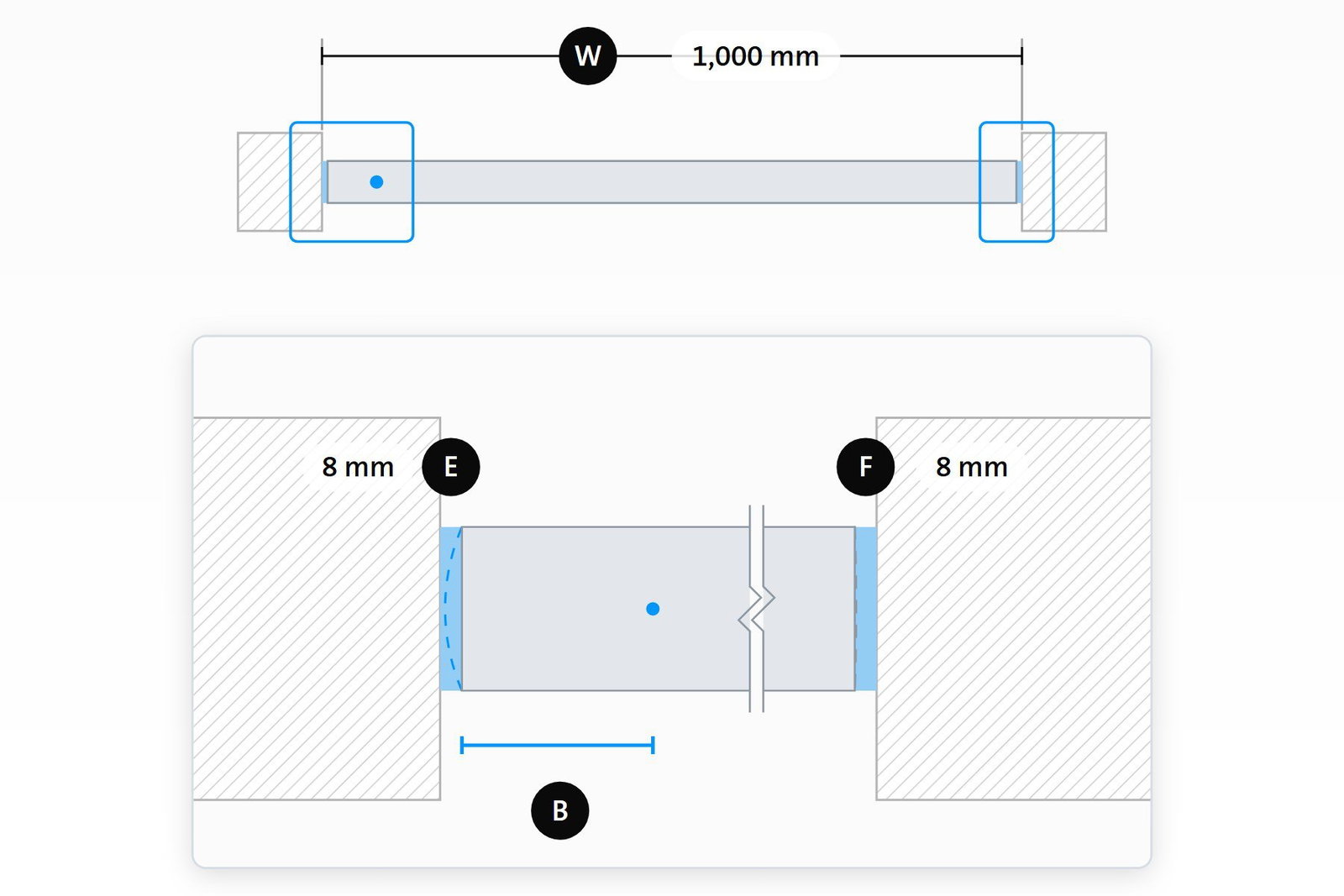
The opening is measured frame to frame. The leaf, the two side gaps and the pivot axis fit within it.
What the result means
- Door leaf width is rounded down to the whole millimetre, so the leaf always fits.
- Pivot side and Far side are set to the same gap, for an even look. The corner on the pivot side needs more room as the door turns, so both gaps take the wider value. A note under the result shows what each side needs on its own.
- Both gaps include a 2 mm tolerance and are rounded to the nearest whole millimetre, which always leaves at least 1.5 mm of it. Do not add the tolerance again.
- Pivot axis from the frame (P) is the pivot point plus the pivot-side gap: the dimension to set out from the frame.
- Opening width needed appears when you start from the door leaf. Compare it with the opening you have.
The top gap is given as a range of 4 to 10 mm. The bottom gap depends on the floor plate: 11 mm with the plate on the floor, 7 mm with a Flush floor plate recessed in the sill or floor. The exact values come with your configuration in the FritsJurgens Selector.
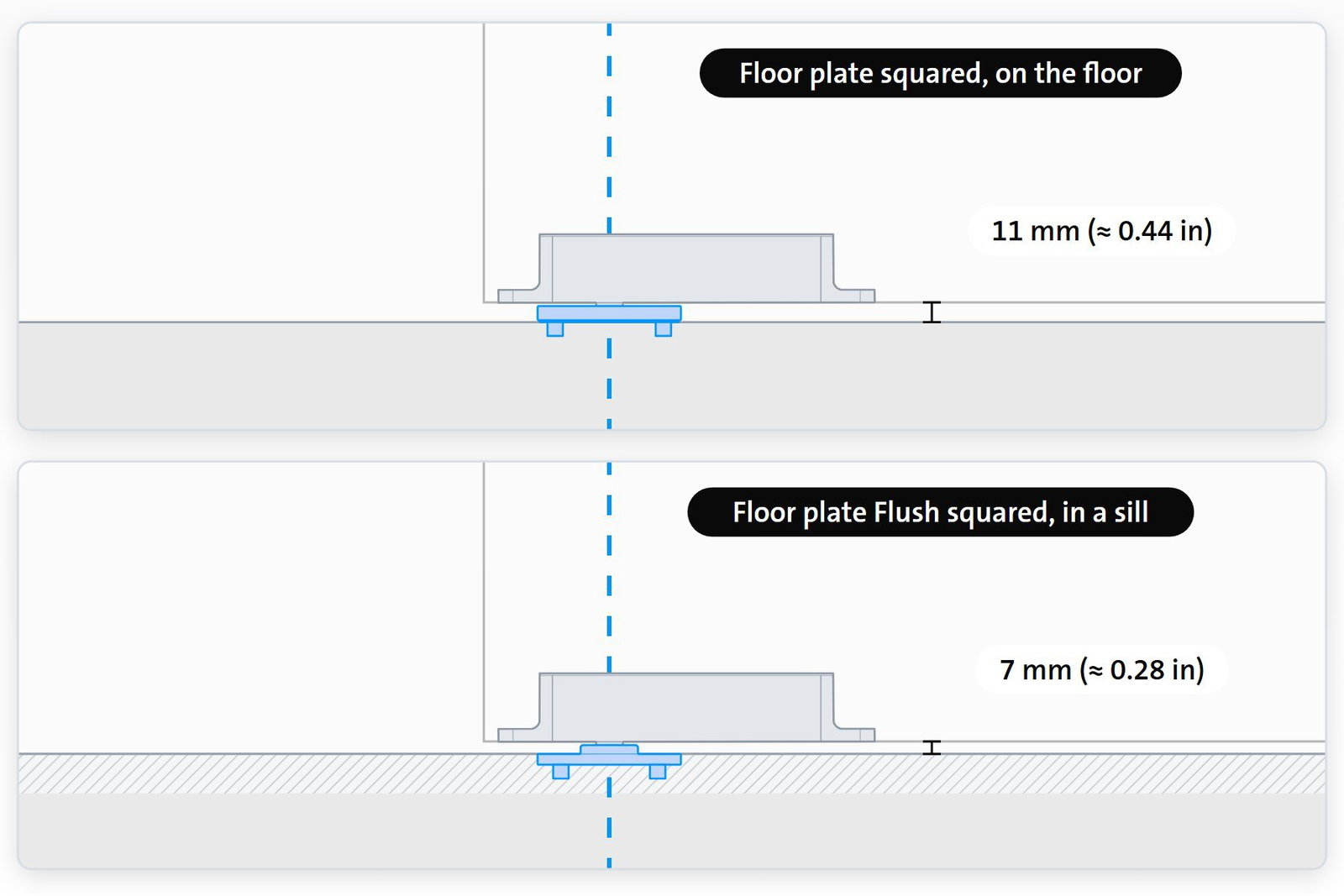
The bottom gap follows the floor plate: 11 mm with the plate on the floor, 7 mm with a Flush floor plate recessed in the sill or floor.
Worked example: a 1,000 mm opening
A single door in an opening of 1,000 mm, with a 60 mm leaf, a pivot point of 70 mm and no pivot offset.
| Single door, 1,000 mm opening | |
|---|---|
| Door leaf width | 984 mm |
| Pivot side | 8 mm |
| Far side | 8 mm |
- 8 + 984 + 8 adds up to the 1,000 mm opening.
- On its own, the geometry needs 8 mm at the pivot side and 2 mm at the far side. Both gaps are set to 8 mm so the door looks even.
- A different pivot point changes the gaps and the lateral force: check the forces in the Lateral Force Calculator.
Double doors
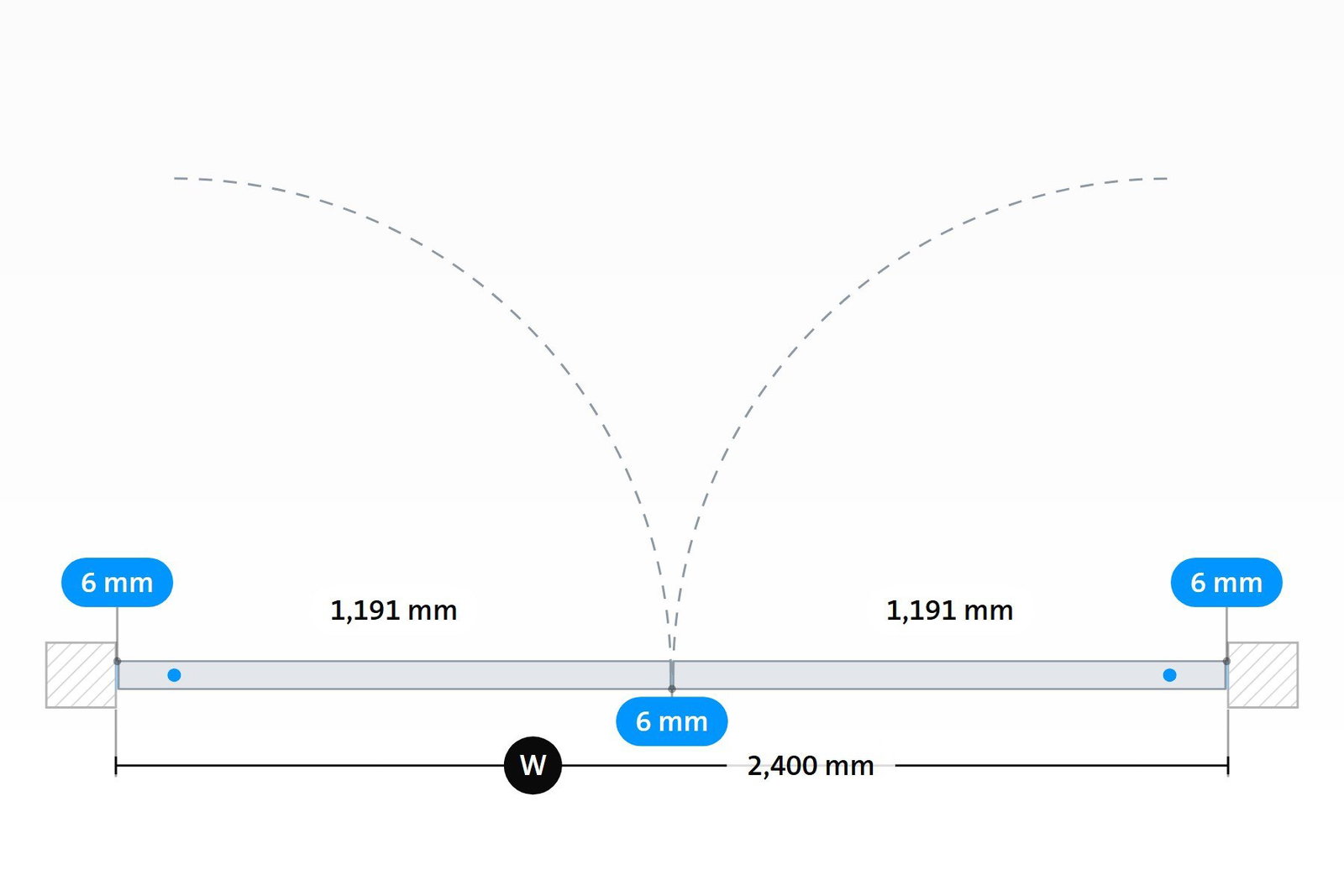
Choose Double door (two leaves) and enter the whole opening, frame to frame. The calculator splits it into two equal leaves.
- All three gaps are equal: at both outer jambs and between the leaves.
- Each leaf takes the same set, so a double door needs two sets.
- The pivot point, thickness and pivot offset apply to both leaves, mirrored.
- System One is not available for double doors.
- Rebated leaves have to close in a fixed order, or the rebates in the centre hit each other. Send us a drawing and we will advise.
| Double door, 2,400 mm opening | |
|---|---|
| Each door leaf | 1,191 mm |
| Gaps, all three | 6 mm |
| Sizes used | Leaf thickness 60 mm, pivot point 120 mm |
Before manufacture and installation
- Confirm the finished opening and the reference points on the shop drawing before the leaf is made.
- Use the finished leaf thickness and the actual edge profile. Check rebates, seals and projecting details through the whole swing.
- Set out the top and bottom pivot from the same pivot axis, following the installation instructions of the chosen system.
- A wider gap does not correct a misaligned pivot axis or a floor that is not level. A difference on site needs an agreed detail.
- "Copy link with these values" shares the inputs between workshop and site. Keep the agreed result with the drawing revision.
Questions about pivot door gaps
Related tools and documentation
- The Lateral Force Calculator works out the forces on the top and bottom pivot for the same leaf and pivot point.
- Downloads holds the technical drawings and installation instructions for every FritsJurgens component.
- The FritsJurgens Selector turns your door requirements into a matching pivot hinge set, with the exact top and bottom gaps.