






Lateral Force Calculator for pivot doors
A pivot door stands on its bottom pivot and is held upright by its top pivot. Enter the size of the door leaf, its weight and the pivot point to see the force each pivot takes.
The calculator cannot be loaded right now. Please try again later.
What to enter
Enter the finished sizes of the moving leaf. The calculator works out the static load from the door's own weight.
- Door leaf width (C) and Door leaf height (H): the leaf itself, without the frame.
- Pivot point (B): measured from the pivot-side edge of the leaf to the pivot axis. The presets match the FritsJurgens top pivots.
- Door weight (m): the whole moving leaf, including cladding, glass and fittings.
- Pivot offset (O): under Special doors, for bookcase doors, very thick doors or a drop seal in the bottom of the leaf.
If the final weight is not known yet, use a documented estimate and calculate again once the build is fixed.
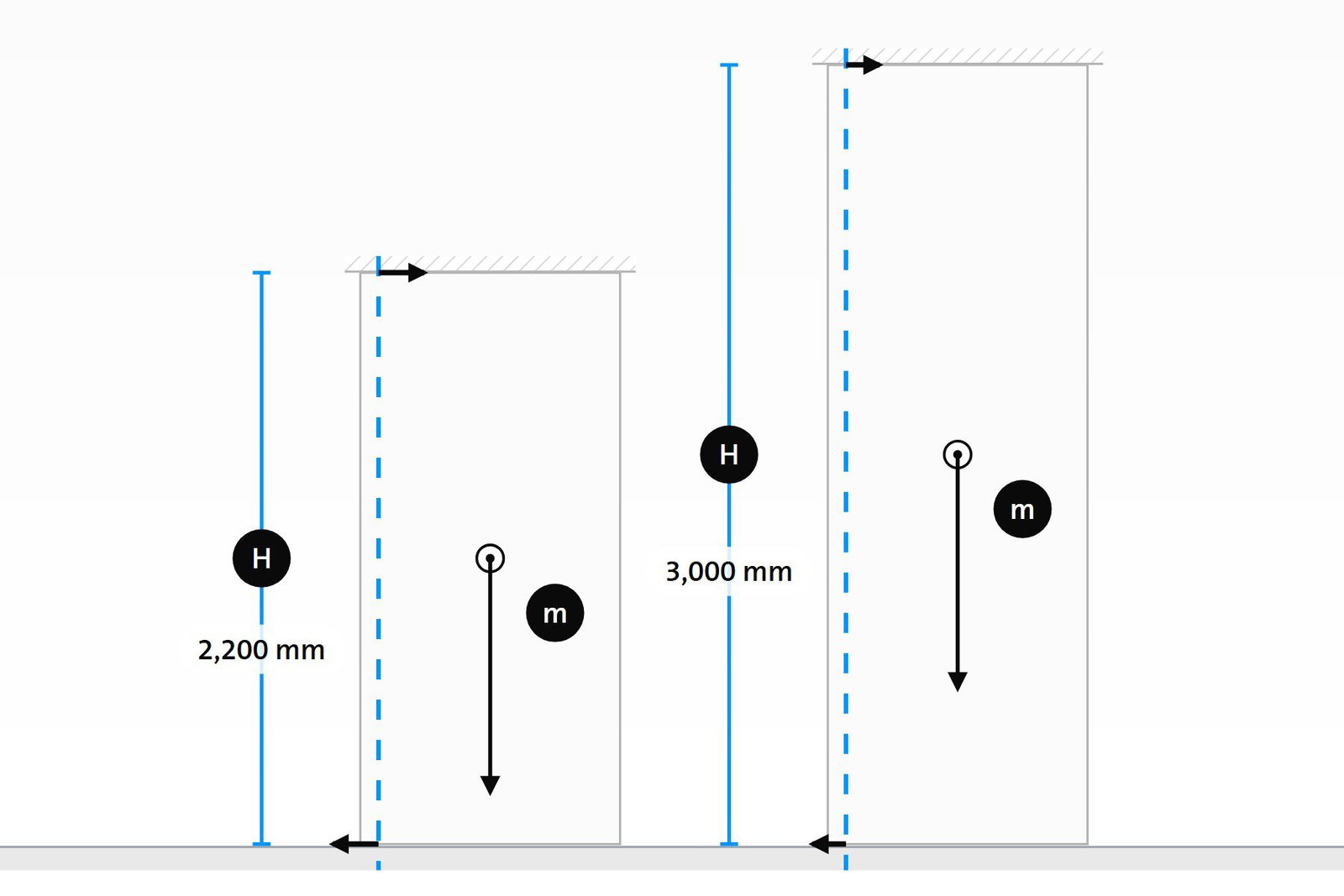
Same weight, taller door: the pivots are further apart, so the lateral force at each pivot is lower.
What the result means
- Lateral force at the top pivot and at the bottom pivot is one figure that acts at each pivot, in opposite directions. A result of 325 N means 325 N at the top and 325 N at the bottom, so do not halve it.
- Vertical load on the bottom pivot is the full weight of the door, carried by the bottom pivot alone.
- The kgf or lbf figure next to a force is the same force in another unit, not a weight to enter.
The calculator gives the loads. Whether the ceiling, the floor and their fixings can take them is a separate check.
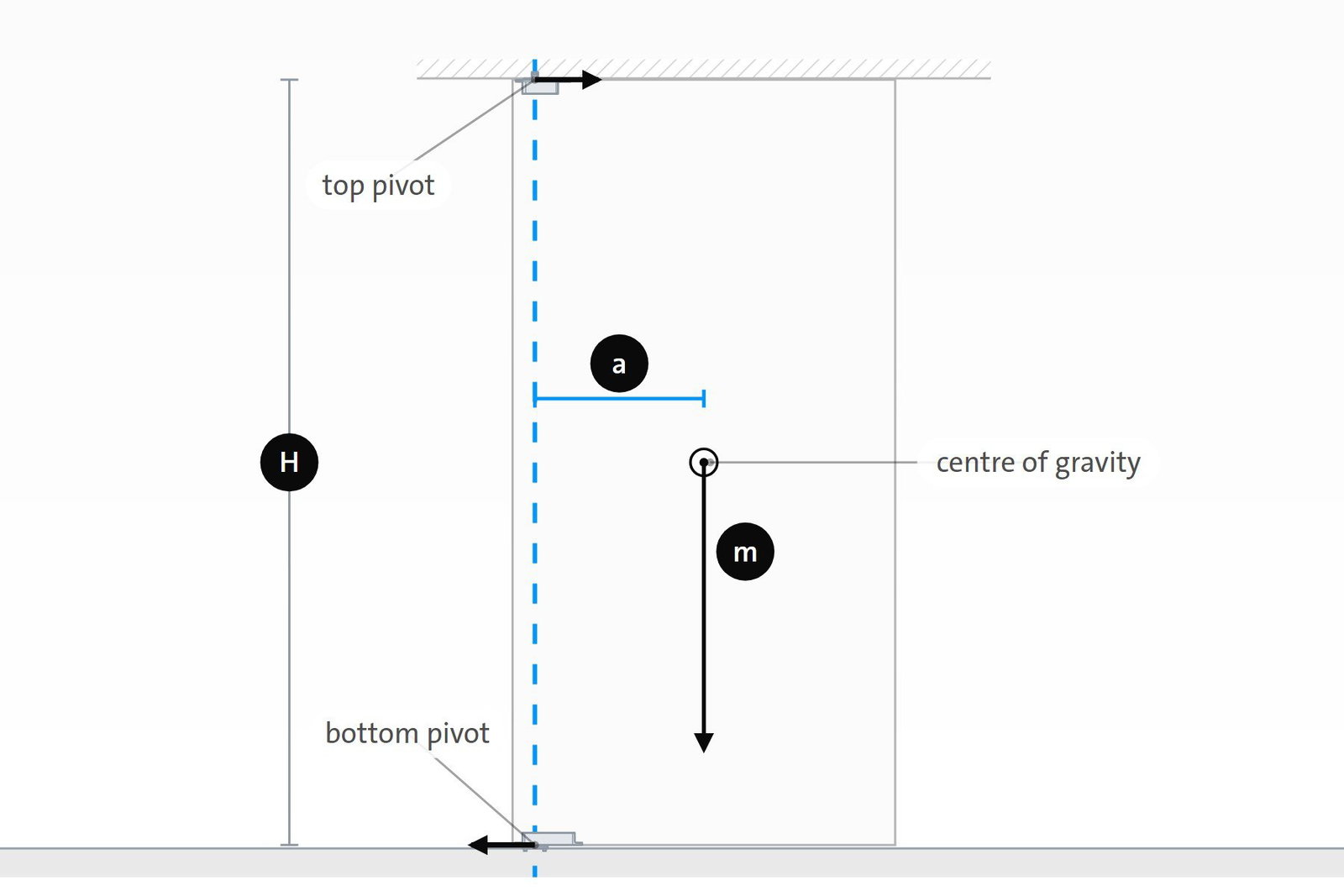
The weight acts at a distance a from the pivot axis. The top and bottom pivot hold the door upright with equal and opposite forces.
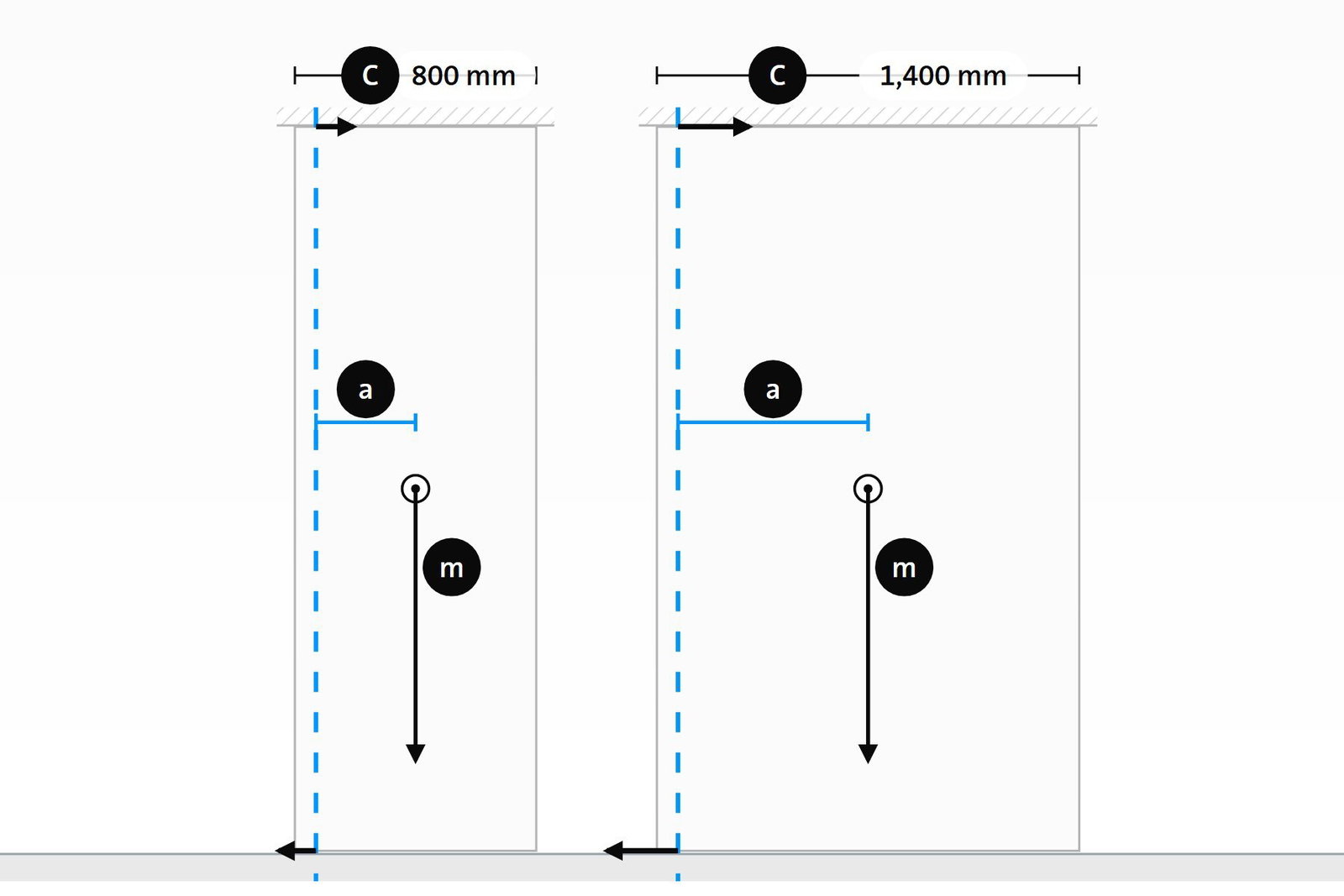
Make the door wider and its weight sits further from the pivot axis, so the lateral force goes up.
Worked example: moving the pivot point
Take a 150 kg leaf, 1,200 mm wide and 2,400 mm high, with its centre of gravity in the middle and no pivot offset. Only the pivot point changes.
| Same door, two pivot points | |
|---|---|
| Pivot point 70 mm | 325 N at each pivot |
| Pivot point 170 mm | 264 N at each pivot |
| Vertical load, both cases | 1,471 N |
- Moving the pivot point 100 mm towards the middle takes about 61 N off each pivot.
- Check that the hardware you have chosen allows that pivot point.
- The side gaps change with it: check them in the Gap Calculator.
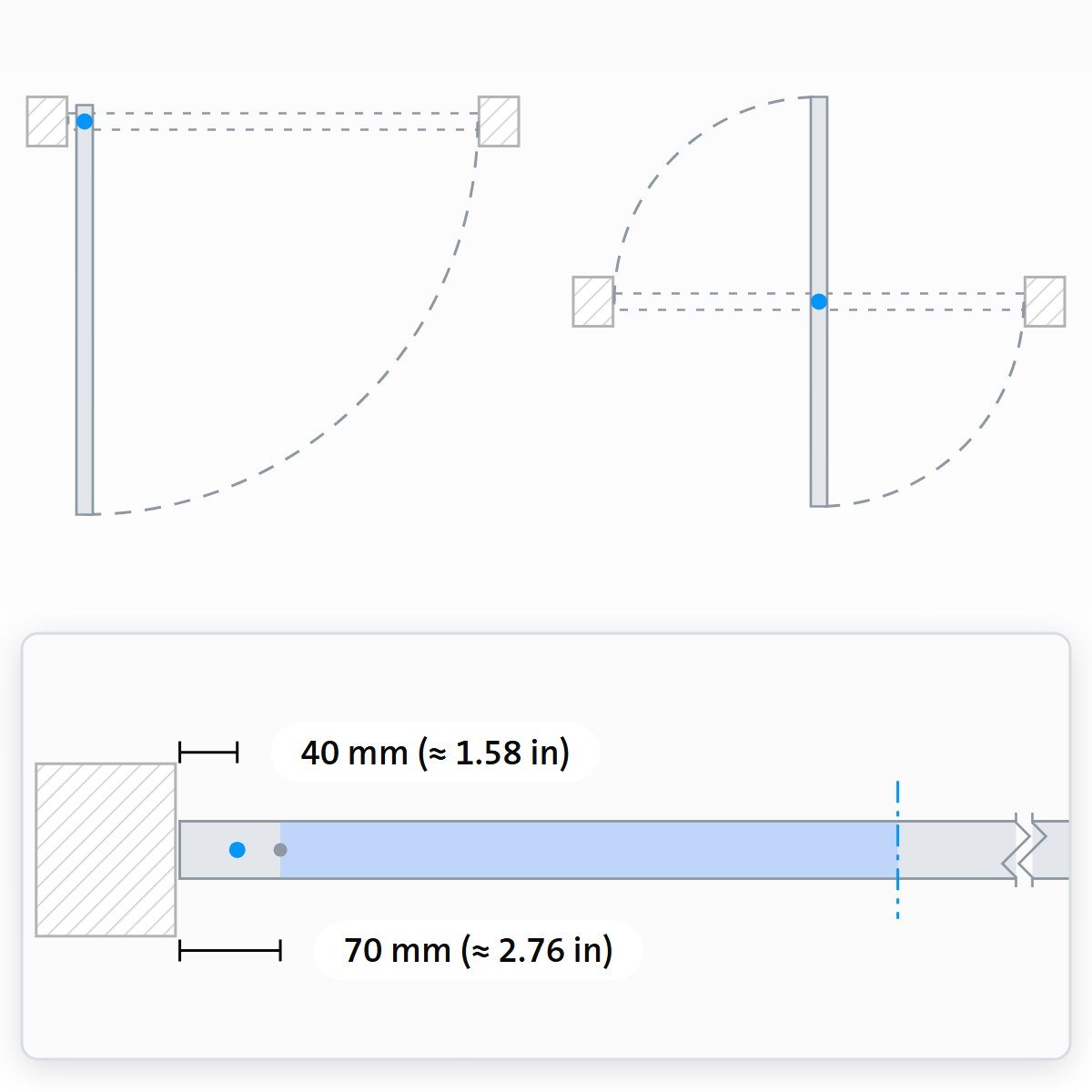
The pivot point is measured from the pivot-side edge of the leaf to the pivot axis: 40 mm fixed or adjustable from 70 mm with the top pivot in the door, and from 130 mm with top pivot Reversed in the head jamb.
Before manufacture and installation
- Confirm the complete weight, the sizes and the pivot point before the door is machined.
- Heavy cladding on one face, or a pivoting bookcase, moves the centre of gravity off the middle. The calculator assumes it sits in the middle, so such a door needs its own calculation.
- To bring the force down, make the door lighter or move the pivot point closer to the middle, within what the hardware allows.
- Pass the loads on to whoever checks the building structure. The ceiling has to resist the lateral force, the floor the lateral force plus the vertical load.
- A suspended ceiling is not a fixing point. Show on the drawing what the ceiling plate is fixed to.
- Use one pivot axis on the workshop and installation drawings, and file the result with the drawing revision. "Copy link with these values" shares the inputs.
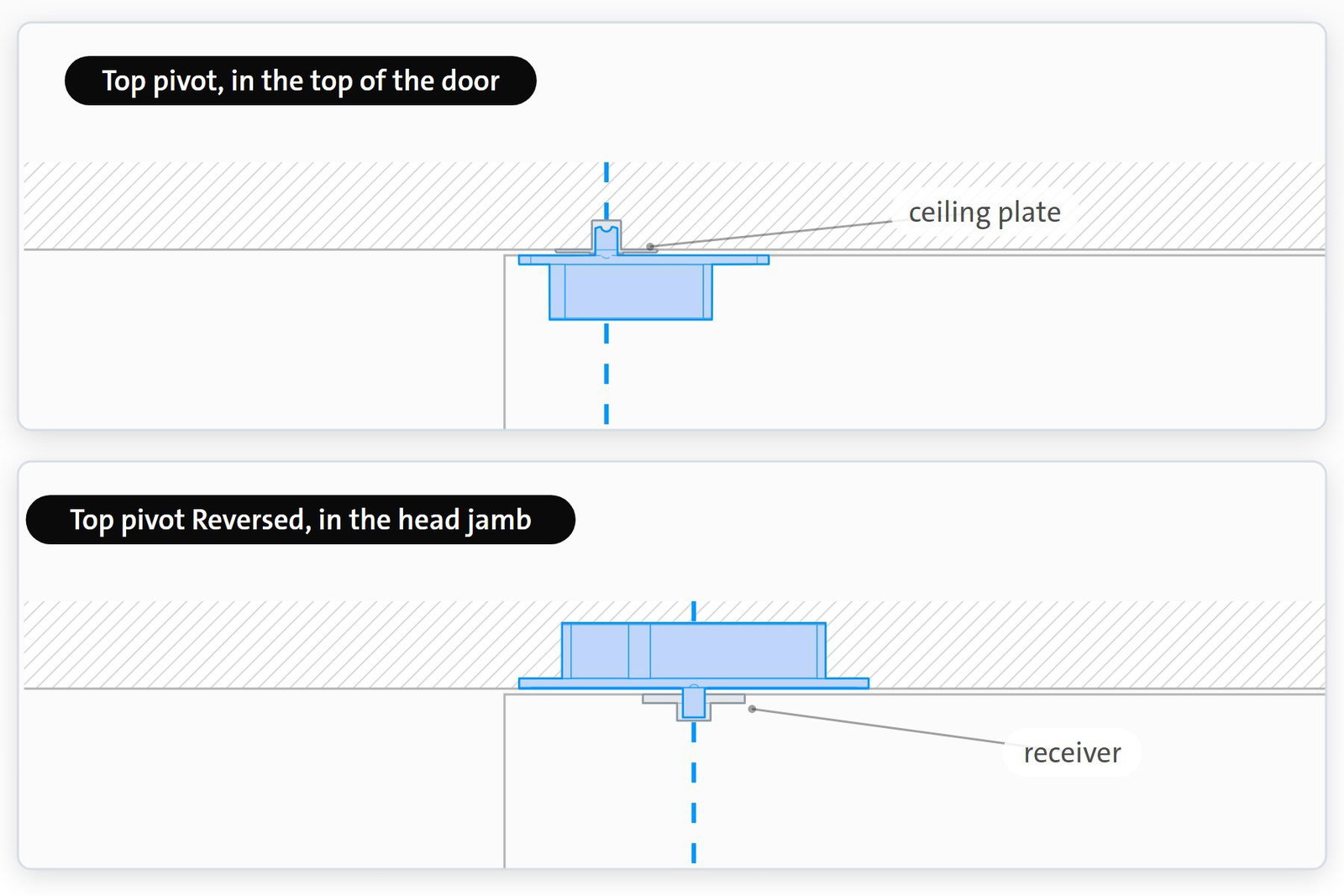
The top pivot in the top of the door, or top pivot Reversed in the head jamb with its receiver.
Questions about lateral force
Related tools and documentation
- The Gap Calculator works out the side gaps for the same leaf thickness and pivot point.
- Downloads holds the technical drawings and installation instructions for every FritsJurgens component.
- The FritsJurgens Selector turns your door requirements into a matching pivot hinge set.